
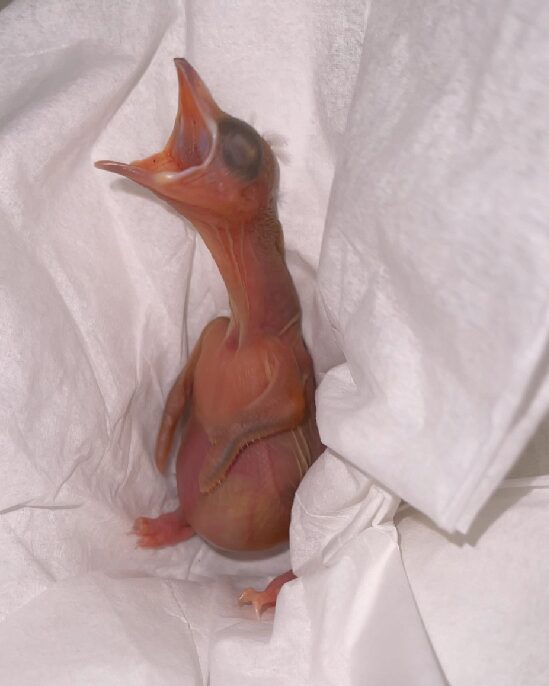
Well, it looks like the busy baby bird season will soon be upon us. The WILVOS 5441 6200 Hotline is starting to get a number of calls about young chicks. Unfortunately, a number of calls have come in because of the removal of large trees, often hollow-bearing trees. This is sometimes unavoidable, but it is still sad to see the number of lorikeet chicks that have come through in the past week.
Identification of the very young is often challenging, but there are always experienced bird carers who can help. The little figbirds are so easily identified by their little windmill heads that keep spinning around as they wait for their food. It doesn’t take long for rainbow lorikeet chicks to make a noise, even when still in a brooder.
Precocial birds, such as the masked lapwings aka ‘plovers’, are a little easier on the wildlife carer. They hatch and are soon mobile and able to feed themselves, though still with their parents for the necessary warmth, protection and life lessons!
On the other side of wildlife rehabilitation we have the time-consuming macropods which may be in care for up to twelve months before they are released with their ‘mob’. Joeys are placed with others around the same size as they become more adventurous. Raised alone, these animals may suffer major problems as they mature, because they have been too dependent on just humans for too long.
Echidna females will soon be depositing an egg in their pouch. By September their pouch is home to a very cute little pink animal. Puggles grow at an extremely fast rate.
There is never a dull moment with our unique native animals. They are so taken for granted, as they disappear at an alarming rate.
All our wildlife volunteers, in their varying capacities, do an amazing part in securing a future for these same native animals.
Donna Brennan Wildlife Volunteers Assoc Inc (WILVOS) PO Box 4805 SCMC Q 4560 PH 5441 6200 www.wilvos.org.au